Wednesday, May 09, 2018

THE BLANKENSHIP SURGE WAS FAKE NEWS, AND I DON'T BLAME THE RIVAL CAMPAIGNS

Hi -- I'm back. Thank you again, Yastreblyansky and Crank, for some great work while I was away.

A lot happened while I was gone and I'm still trying to sort it all out. For now I'll just address the results of the West Virginia GOP Senate primary. Don Blankenship, the racist felon coal baron, finished third, 15 points behind the winner, Patrick Morrisey. That shouldn't be surprising because the last two public polls, from GOPAC and Fox News, showed Blankenship in third, 8 and 9 points behind the leader, respectively. It was surprising because, shortly before the election, Politico and the Weekly Standard reported on internal polls from rival campaigns claiming that Blankenship was in the lead.

Nate Silver expressed skepticism about the polls in real time.


Last night, after the polls closed and it was clear that Blankenship was losing badly, Silver wrote,
I’m not just being a smartass when I put “polls” in scare quotes; there are so many ways to manipulate polling results (e.g. fudge around with your turnout model) so as to produce a desired narrative that the results may as well be fake. And every now and then, internal “polls” probably are just made up on the spot....

In this case, it seems pretty likely that the internal “polls” showing Blankenship surging represented gamesmanship on behalf of the other two campaigns ... as much as they did anything real.
But why would the campaigns release polls showing that they're trailing when there was another narrative showing each one in the lead? (The GOPAC poll had Morrisey up by 4, while the Fox poll had Evan Jenkins up by the same amount.) If those campaigns wanted to release fudged polls, why didn't each campaign release a poll naming its candidate as the front-runner?

Who really benefited from the thwarted-Blankenship-surge narrative? Two people: Mitch McConnell and Donald Trump.

McConnell worked hard to defeat Blankenship, while Trump weighed in with a late tweet. Blankenship now believes that the tweet cost him ten or more points in the race.

I think McConnell knew that Blankenship was toast but wanted to convey the impression that crossing him (and Trump) was an extremely dangerous thing to do. The victory of Roy Moore in the Alabama Senate primary last year cast serious doubt on McConnell and Trump's ability to get an electable candidate through a contentious intraparty contest. Now -- even though Blankenship probably lost all on his own -- they can say they have their mojo back.

So I think this Blankenship-surge narrative came from McConnell, and maybe Trump's people, not Morrisey or Jenkins.

West of Eden: Deal Away

Chahar Bagh School, or School of Sultan Hossein's Mother, Isfahan, 19th-century drawing by Pascal Coste, via Wikipedia.

Money quote, for my money, from the press questions after Trump's announcement:
REPORTER: Mr. President, how does this make America safer? How does this make America safer?
TRUMP: Thank you very much. This will make America much safer. Thank you very much.
Oh, that's how. In a much kind of way. Not somewhat or a bit. It's the muchness, stupid.

I didn't listen to the speech, but the way folks were describing his delivery (somebody on Twitter said he was "reading it phonetically") made it sound clear that he'd spent even less time reading it ahead of time than he normally does, which means around zero, and had no idea what it said. Though you can see a dim understanding floating by in a couple of Trumpy interpolations, like
In other words, at the point when the United States had maximum leverage, this disastrous deal gave this regime — and it’s a regime of great terror — many billions of dollars, some of it in actual cash — a great embarrassment to me as a citizen and to all citizens of the United States.
the reference to $1.7 billion as "many billions" and "actual cash" as if there were something particular sinister about that (cash was important to them as it would take some time for international banks to lift the sanctions), or his cute attempt to put himself in Ayatollah Khamenei's place—
Iran’s leaders will naturally say that they refuse to negotiate a new deal. They refuse, and that’s fine. I’d probably say the same thing if I was in their position. But the fact is, they are going to want to make a new and lasting deal, one that benefits all of Iran and the Iranian people.
John Bolton didn't write that bolded bit, but I'm sure he or his assistants wrote all the words Trump saw on the TelePrompTer, like the dire accusation against Iran's buildup of its military spending
In the years since the deal was reached, Iran’s military budget has grown by almost 40 percent — while its economy is doing very badly. After the sanctions were lifted, the dictatorship used its new funds to build its nuclear-capable missiles, support terrorism, and cause havoc throughout the Middle East and beyond.
without noting that that was $14 billion total in 2017, up from $10 billion in 2013, but well below the $15 billion it hit in Anno Bushii 2007.

Tuesday, May 08, 2018

Thanks, Obama

Via Top 10 Kids Who Survived the Impossible.

There's also some unexpectedly cheering news, which is that my favorite part of Obamacare, the part nobody else cares about which I regard as the gateway to a European-style universal health care system—the employer mandate—has survived!
While the individual mandate may be dead, the employer mandate — the requirement that many companies offer health insurance to their workers or pay a penalty — is very much alive. Under Mr. Trump, the Internal Revenue Service has been pursuing companies that fail to comply with the mandate and, according to the agency, was sending penalty notices to more than 30,000 businesses around the country.
Former IRS commissioner John Koskinen explained:
“The I.R.S. does not have the authority not to collect the money,” Mr. Koskinen said in an interview, adding that there was no reason to hold off on penalizing companies. “Delaying wouldn’t accomplish anything except delay.”
I have to protest against one complaint:
“The employer mandate always existed to support the individual mandate,” said Jim Klein, president of the American Benefits Council. “There’s no logic or fairness in having an employer mandate in the absence of having an individual mandate.”
That's exactly the opposite of the way it should be working, as I've been trying to explain for a long time, and I'm not sure who's getting it.

The "individual mandate" isn't a requirement that everybody has to buy health insurance: it's a requirement that everybody who isn't covered otherwise has to buy it, and under Obamacare, that's a fairly small number. A healthcare delivery system like the ACA, or the Massachusetts Democrat-designed program it's modeled on (obligatory reminder that it is not a "Heritage plan" and was passed over Romney's vetos), is meant to ensure that everybody with a job gets high-quality low-cost healthcare, the way the lucky ones like me already did, more or less ("If you like it you can keep it"—well, I do have a bunch of improvements I could suggest) between the underemployed (Medicaid) and the retired (Medicare). And the program is to get the employer to write the checks, with the economies of scale that provides, as in France. (ACA allows employees to be forced to share quite a lot of the costs,  which is a defect.) That's the employer mandate, which is the central thing.

Which means the self-employed, people who are their own employees, have to pay their own, as in France, and that is the requirement we call the individual mandate. The individual mandate in the ACA is the requirement that if you are your own employer (or work in a company regarded as too small to insure you, 50 or fewer employees), you have to take care of it yourself. Around 9% of the population, last time I was looking at the numbers, which is kind of a while. Though some people (like Barack Obama in 2008) insisted it wasn't necessary, because the self-employed would willingly buy in.

It looks clearer than ever now that Trump has rescinded it that an individual mandate is a good idea, and Connecticut and some other states are considering restoring it at state level, but it really isn't the main thing. It always existed to support the employer mandate and not the other way around.

Cross-posted at The Rectification of Names.

Monday, May 07, 2018

Bad


OK, I'm really sad now. I've long had a kind of personal thing about Schneiderman, in that when he was a state senator and I was a harried househusband our kids were in the same public school, not that I've ever met him, and I've loved watching him fight the good fight in our national emergency, suing the Trumpery right and left and stopping evil in its tracks. That will go on, obviously it's the staff that does all the work, not the attorney general himself, but he was just not supposed to be like that; he was supposed to be on the clear right side, as Mayer and Farrow write:
Eric Schneiderman, New York’s attorney general, has long been a liberal Democratic champion of women’s rights, and recently he has become an outspoken figure in the #MeToo movement against sexual harassment. As New York State’s highest-ranking law-enforcement officer, Schneiderman, who is sixty-three, has used his authority to take legal action against the disgraced film mogul Harvey Weinstein, and to demand greater compensation for the victims of Weinstein’s alleged sexual crimes. Last month, when the Times and this magazine were awarded a joint Pulitzer Prize for coverage of sexual harassment, Schneiderman issued a congratulatory tweet, praising “the brave women and men who spoke up about the sexual harassment they had endured at the hands of powerful men.” Without these women, he noted, “there would not be the critical national reckoning under way.”
Now he's denying the very persuasive, and awful, stories that are being told about him. My kneejerk partisan first thought was like the first thought I had about Al Franken, that he must be the victim of some kind of conspiracy (I still kind of hope it's in some sense true of Franken) but you can't—at least I can't—sustain the thought for even a page of this story (here's a link to the Times coverage). It's really very bad. Damn.

Cross-posted at The Rectification of Names.

Sunday, May 06, 2018

Inner Nixon: Update


The story is getting somewhat wild today: Colin Kahl, the Biden national security adviser named in the Guardian story as one of the people being spied on in a Trump-sponsored effort to discredit the Iran deal, initially reported, like Ben Rhodes, that he hadn't noticed anybody spying on him, but then, as he and his wife talked it over, they remembered something kind of untoward (you should read the whole thread):
The brilliant Middle East expert journalist Laura Rozen (who some older Netizens may remember as blogger Needlenose, one of the most reliable voices on the Iraq War) was struck by a strange echo in Kahl's story of something you'd think was completely different, the story of the persecution of actress Rose McGowan, as reported in Ronan Farrow's New Yorker story on the Harvey Weinstein sexual violence cases; McGowan was spied on by an Israeli private intelligence agency, called Black Cube
And the fake British equity firm Black Cube invented as the cover for their interrogators with McGowan, "Reuben Capital Partners", is the same as the firm that interrogated Mrs. Kahl last May:

So the same firm, owned and staffed by veterans of the elite Israeli intelligence agencies, using the same techniques and covers, helped Weinstein (a former partner in one of Stephen Bannon's enterprises, for what it's worth which may not be much) to try to intimidate his most formidable accuser, and helped the Trump White House to try to compromise former Obama staffers with a connection to the Iran deal.

And that's not even all: Christopher Wylie, the former research director at (Robert Mercer–owned, sometime Stephen Bannon–run) Cambridge Analytica who blew a number of whistles on the company last March, brought up Black Cube in his testimony: he claimed Cambridge Analytica had hired Black Cube to ratfuck Nigerian presidential elections on behalf of President Goodluck Jonathan, hacking the health records of his opponent Muhammadu Buhari and what I think is worse:
Buhari won election in 2015, but had unsuccessfully run three times before, when Wylie said AggregateIQ [the Canadian subsidiary of Cambridge Analytica's owner] handled the hacked data and also distributed threatening anti-Islamic videos that showed people's throats being cut in an effort to intimidate voters. (New York Daily News)
Black Cube and (the now disbanded) Cambridge Analytica have denied all of this, but, to use a favorite Trump expression, we'll see. If it gets any spookier, I'm calling Ghostbusters.

Cross-posted at The Rectification of Names.

Saturday, May 05, 2018

Trump Unleashing His Inner Nixon


Filing Cabinet of Dr. Lewis Fielding, with markings where Hunt, Liddy, Martinez. and the others broke into it in the hopes of finding out something nasty about Daniel Ellsberg, a patient of Dr. Fielding's, in 1971; Smithsonian Institution, National Museum of American History, via Wikipedia.


Progressives who'd rather we stop talking about Russia Russia Russia and Trump's criminality might take a look at this story, just out in The Guardian, which has nothing to do with Russia: It seems that a year ago, just after Trump's visit to Tel Aviv (when he promised Netanyahu that he would ensure "Iran would never have nuclear weapons"), his people hired a private Israeli intelligence agency to "get dirt" on the personal and political lives of Ben Rhodes, President Obama's deputy national security adviser for strategic communications, and Colin Kahl, former national security adviser to Vice President Biden, which they hoped "would discredit those who were pivotal in selling the deal, making it easier to pull out of it."
Among other things they were looking at personal relationships, any involvement with Iran-friendly lobbyists, and if they had benefited personally or politically from the peace deal.
Investigators were also apparently told to contact prominent Iranian Americans as well as pro-deal journalists – from the New York Times, MSNBC television, the Atlantic, Vox website and Haaretz, the Israeli newspaper among others – who had frequent contact with Rhodes and Kahl in an attempt to establish whether they had violated any protocols by sharing sensitive intelligence. They are believed to have looked at comments made by Rhodes in a 2016 New York Times profile in which he admitted relying on inexperienced reporters to create an “echo chamber” that helped sway public opinion to secure the deal. It is also understood that the smear campaign wanted to establish if Rhodes was among those who backed a request by Susan Rice, Obama’s final national security adviser, to unmask the identities of Trump transition officials caught up in the surveillance of foreign targets.
This is pretty clearly Nixon-level skullduggery, reminiscent of the original Plumbers burglary when they attacked Daniel Ellsberg's psychiatrist's office, with the added weirdness of using a foreign agency, and similar to what the Trump people are alleged to have done with Russian agents and a British firm trying to "get dirt" on Hillary Clinton in the campaign period. It's also similar in the tie-in of allowing foreign leaders to dictate US policy—Netanyahu for the Iran deal, Putin for the Ukrainian and Syrian issues, not to mention old Flynn offering US cooperation to the Turkish authoritarian president Recep Tayyip ErdoÄŸan.

Or Trump selling his acquiescence to Saudi's blockade of Qatar last summer, which seemed connected to Jared Kushner's failing to get a loan from Qatar for his debt on the 666 Fifth Avenue building, or Trump's new friendship with Qatar, to which the US has just sold $197 million worth of missiles, and Trump himself has sold a $6.5 million apartment in Trump Tower to go along with the other three units, worth about $10 million, they already own.

It's very Trumpy that there's a discernible profit motive in special cooperation with the Netanyahu government, at least for Jared (who seems to have vanished from view in recent weeks), because the Kushners seem to have huge investments from Israelis and interests in Israel, including the official charity of the Israel Defense Forces:
Another key Israeli beneficiary is the Israel Defense Forces. Between 2011 and 2013, the family foundation donated a total of $315,000 to Friends of the IDF (FIDF) – a U.S. organization doing fundraising for the Israeli army. Indeed, until he joined the Trump administration in January 2017, Jared Kushner served on the FIDF national board. A day after Haaretz submitted questions to FIDF and a Kushner family spokesperson about his continued involvement on the board, his name was suddenly removed from FIDF’s website.
But there's something especially Nixonian about this particular episode, too, in its narrow focus, in its concern with "enemies"—we all understand Trump's personal stake in abrogating the JCPOA is to wound Obama and undo his accomplishment, and we see how this project goes after the reputations of people who are loyal to Obama as well. Note also the implied recognition that there isn't a legitimate case against the JCPOA:
Jack Straw, who as foreign secretary was involved in earlier efforts to restrict Iranian weapons, said: “These are extraordinary and appalling allegations but which also illustrate a high level of desperation by Trump and [the Israeli prime minister] Benjamin Netanyahu, not so much to discredit the deal but to undermine those around it.”
It's not even the only apparent ratfucking going on as we approach Trump's deadline for withdrawing from the Iran deal; Twitter lit up today with the story of former secretary of state John Kerry working on something like his old schedule to salvage the deal, having meetings with Mohammed Zarif, German president Frank-Walter Steinmeier, the EU's Angela Mogherini, and France's Emanuel Macron, and this completely open and above-board activity—
The rare moves by a former secretary of state highlight the stakes for Kerry personally, as well as for other Obama-era diplomats who are dismayed by what they see as Trump’s disruptive approach to diplomacy, and who view the Iran nuclear deal as a factor for stability in the Middle East and for global nuclear nonproliferation. The pact, which came after a marathon negotiating session in Vienna that involved Iran and six world powers, lifted sanctions in return for Iran stopping its pursuit of nuclear weapons.
“It is unusual for a former secretary of state to engage in foreign policy like this, as an actual diplomat and quasi-negotiator,” said Michael O’Hanlon, a foreign policy expert at the Brookings Institution. “Of course, former secretaries of state often remain quite engaged with foreign leaders, as they should, but it’s rarely so issue-specific, especially when they have just left office.”
—is being treated by rightwingers, completely wrongly, as a violation of the Logan Act of 1799.

Even if you think the Russia collusion is kind of amorphous and unprosecutable and not even a necessarily bad thing, you should recognize that this ratfucking after Trump has become president, in aid of Netanyahu and Trump's own private hatreds, and against peace in the Middle East, is very bad, and distinctly criminal, because the law on it was all worked out in 1974.

Cross-posted at The Rectification of Names.

Friday, May 04, 2018

"Stormy news won't move the needle on Trump". And you're surprised?

Oxford-Cambridge goat race, 24 March 2018, via londontown.com.

This sequence goes from dismal to somewhere productive:


I've never understood arguments in the form "People shouldn't talk about how X is a bad person, they should focus on the issues" or the other way around. Obviously candidates and editorialists and partisans of all varieties should talk about the issues as much as they think their audience can stand, and they can probably stand more than your average campaign manager thinks they can, but if your opponent is a genuinely bad person and you can make some use of that, you might as well.

But in the present situation, I really can't understand why anybody should think it's a problem, as if laying off Trump might get Democrats some of those votes from people who've decided they don't care if Trump is a liar or a fornicator or criminal or traitor as long as that wall gets built or Trump is on the air demanding that the wall get built. There is nothing that is going to change their minds. You can talk about the issues until you faint. You will not get that vote by insulting Trump and you will not get it by not insulting him. It really doesn't matter either way.

But there are other votes. There are the people who voted Libertarian or Green rather than R or D in 2016, and I don't think a lot of them and their gettability, or numbers either. There are some genuine NeverTrumpers out there, too, who voted for Ron Johnson in Wisconsin (ugh) or Pat Toomey in Pennsylvania but couldn't bring themselves to check the Trump box and voted for Hillary Clinton, that's the way she got her three-million–vote plurality. And above all there are a lot of Democrats, or people who know they ought to be Democrats, who just didn't vote in 2016, because they just didn't have a good reason to do it, including those who were halfway or better convinced by the propaganda they saw on Facebook that Hillary Clinton was just as criminal as Donald Trump. Which is not a small number, as we know, and a remarkably large number of them blamed the candidates and the issues:

What’s that? There’s a glitzy building around the corner emblazoned with the Trump name? There goes the neighborhood!

Uh oh! Trouble in Glitzville!

Since Donald Trump became president, “…Trump branded buildings in New York have lagged behind the luxury market, selling for about 6.6 percent less than the average Manhattan condominium in 2017,” reports the New York Times.

A rose by any other name 
might  actually stink —
and Trump ain’t no rose

What’s that? You mean those big, glitzy, golden, all-capital letters, spelling out the name “TRUMP”  on buildings actually decrease property values? Evidently. You might as well put the name “CRAP” or “TURDS” or some such on on a building and hope some suckers will want to live in it.

This piece of news, likely gloomy for Trumpistas everywhere, emerged in a story that ran in the New York Times on Friday about a 46-story condominium on the  Upper West Side of Manhattan, that seems about to vote to remove Trump’s name from their facade — perhaps to increase the value of their property.

In any case, the move is almost certain to decrease the level of embarrassment for occupants of the building that comes from having any connection at all with the Trump name. Little wonder, according to the Times, that fewer than a quarter of the building’s 377 condo owners want to retain the Trump name.

The folks who vote to get Trump off their property, or at least to get his name off their facade, will be willing to do so even though it’s going to cost them — and cost them plenty. The building’s board of directors has estimated that it will cost them $19,000 just to remove  the letters spelling out Trump’s name. But that’s just the beginning.

Evidently, letters hanging on a building for roughly 19 years have the same effect as a picture hanging on a wall in your living room for nineteen years. Take the picture down, and there’s a shadow of the picture where the picture used to be. So more expenses.

The Lady Macbeth Syndrome

The building will have to spend $23,000, says the Times, “to wash the facade of the building afterward.” Evidently, it takes a whole lot of scrubbing to erase the stain of the Trump name. Or as Lady Macbeth put it while compulsively washing her hands, "Out, damned spot! Out I say!"

And speaking of great names in compulsive-obsessive behavior, Trump, who sued in advance of the vote to stop the removal of his name, lost in court. But he plans to keep the suit going anyway, with an appeal. My guess is that his appeal will go, if not to the very gates of hell, at least to the U.S. Supreme Court. (Assuming there is any difference between the two.)

Sue? Sue why? Evidently, when Trump was selling condos in the building, he granted the building the right to put his name on it in perpetuity. There’s nothing I’ve seen reported in the contract that says the building has to keep his name on it. Anyway, that’s what a judge in New York said, in giving the Trump organization the back of his hand.

A huffy hissy fit

You may not be surprised to learn that the Trump organization got mighty huffy about the judge’s decision, calling it “unprecedented” and “limited to a technical issue.” Some of us New Yorkers are waiting with baited breath to learn what that technical issue might be, or what’s “unprecedented” about the notion that if it isn’t in the contract, it isn’t in the contract.

Nevertheless, the Times reports that the Trump organization plans to appeal. If you ask me, this is part of a long established legal tradition, perhaps learned by Trump from the late Roy Cohn, that even if you can’t win you can win, just by making the quest for justice so expensive for the other side that they throw up their hands and surrender. My ex-wife’s matrimonial lawyer hewed to the same strategy. Trust me on this because I know from personal experience. It works.

Or, to quote from the Times again, “…some residents are concerned about being ensnared in costly and lengthy litigation. ‘I would rather the building spend money on a long gestating renovation project than this litigation,’ said the longtime resident, who asked for anonymity because feeling are running hot in the building.

For some, the Trump 
name is cringeworthy

Meanwhile, plenty of occupants of Trump-y buildings around the hemisphere would rather fight and switch the monicker of their buildings. Condo owners of the Trump Parc in Connecticut are also considering getting the damned name off their building. And two hotels that once bore the Trump name have decided they could be more prosperous without it — the former Trump hotel and condominium in Panama City and  the former Trump International Hotel and Tower in Toronto, 

Or as one occupant over the Upper West Side Trump condo building said, “There are lots of us who cringe when people associate the building with his name.”


SEE YOU NEXT WEEK -- AND I HOPE THIS TRUMPERDAMMERUNG ISN'T AN ILLUSION

I'm traveling to see family, so I'll be away from the blog until Wednesday, but the relief crew will be here while I'm away.

I'm leaving at a time when it's widely believed that the president is making fatal missteps -- The New York Times says he's losing control of his narrative, while Slate and the Times say that even Fox News isn't safe for him anymore.

Yes, I know that what Rudy Giuliani said on Sean Hannity's show exposes Trump legally. Yes, I know that Fox's Neil Cavuto denounced Trump (“I guess you’re too busy draining the swamp to ever stop and smell the stink you’re creating”). But the Cavuto moment doesn't mean much -- Fox has always permitted occasional, if infrequent, denunciations of sacred cows (usually by Shepard Smith);
Fox loyalists inevitably say in right-wing comments sections that the Fox apostate is a "swamp creature," and some insist that they'll no longer watch Fox, but the rest continue to turn it on at breakfast and leave it on until bedtime.

As for the strategy spearheaded by Giuliani, I think it's legally problematic but emotionally brilliant. In Giuliani, Trump has found the one person who might rally the deplorables as effectively as he does. Giuliani hates the enemies of Trumpism as viscerally as Trump does (he's hated us for decades, long before it was Trumpism), and as repulsive as he is, he has real presence on TV. This is a moment when Trump is, by all accounts, "unleashed," doing things according to his own instincts, and is seeing a slight uptick in his polls. I don't think that's a coincidence. The point of Trumpism is to give the Trump rabble the joy of rage. Giuliani is very good at that.

Trump's strategy right now is to intimidate and to win in the court of public opinion -- or at least the opinions of heartland whites, who are the only people he cares about. The conventional wisdom may be right and he may really be hastening his own downfall, but I'm not so sure, and I suspect that whichever is the case, he'll be doing better in the polls with Giuliani as his surrogate than he was doing before.

Thursday, May 03, 2018

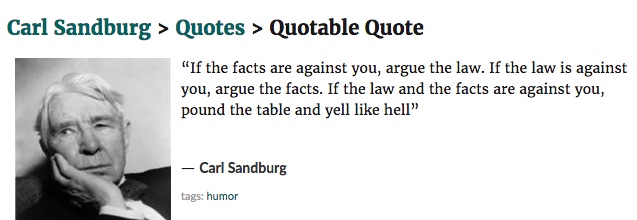
IF THE LAW AND THE FACTS ARE AGAINST YOU....

Whether it was really Sandburg's advice or not -- online quote attributions are notoriously unreliable -- this seems to be the Trump/Giuliani strategy right now:


Josh Marshall watched udy Giuliani on Sean Hannity's show last night and doesn't think it's much of a strategy:
What you have are a half dozen brainstorms cooked up by a group of old men in a room used to bending reality to their purposes when something goes wrong. That’s much more difficult on a national stage in front of intense scrutiny. That’s what happened last night. Rudy Giuliani is far, far past his prime, used to the accommodating hothouse world of Fox News cronies and cash and carry deal-making in his law firm gigs. This was as sloppy as it looked and did his client no favors.
But I keep thinking about this exchange between Tommy Vietor, an Obama administration alum, and Maggie Haberman of The New York Times:


Trump and Giuliani seem to be trying to focus everyone's attention on Michael Cohen's payment to Stormy Daniels and Trump's payment to Cohen. These payments are serious legal trouble for Trump because they might be ... um, violations of campaign finance laws. I think Trump and Giuliani believe it would be good for Trump if that's where the law's attention is focused. Their case will be: Really? You want to bring down this presidency for a campaign finance reporting error? They'd love to rally the base with the seeming injustice of that.

Betty Cracker is certain it won't work. She focuses on a moment in Rudy Giuliani's interview on Sean Hannity's show last night when Giuliani fed red meat to the base on a different subject, claiming he'll "get on my charger and go right into their offices with a lance" if Ivanka Trump becomes a target of the investigation:
The approach seems predicated on the mistaken belief that the view from Fox News holds sway across the land. Would millions rise up to follow Giuliani’s lead — mounting steeds, seizing lances and charging into Mueller’s office to defend Ivanka Trump’s honor? Outside of a relative few loud-mouthed Fox rage-bots, my guess is nope.

But it’s not surprising that these morons think this way — it comes straight from the top. To the extent that he governs at all, Trump governs as if the only Americans who exist are the goobers who support him.
Except that our political system often functions as if the only Americans who exist are supporters of the GOP. Two of the last five presidential elections were decided in favor of the Republican popular-vote loser. It's widely accepted that Democrats might not win a House majority in the midterms even if they win the overall popular vote by a considerable margin; the only debate is whether Democrats' winning margin has to exceed 7 points, 8 points, or more.

In addition, the mainstream press often acts as a force multiplier for Trump's deplorables, defining them as "the working class" (when the working class is actually multiracial) and treating them as if they're the only true Americans, and the only Americans who are suffering from changes to the global economic order. So if Trump and Giuliani succeed in getting them enraged about the investigations, the media's messages really might "America is sick of the investigation."

The dangers Trump faces don't depend on majority rule. Anyone in Trump's orbit who goes to a jury trial will need only 1 in 12 to acquit escape conviction. If Trump is impeached, he needs only 34% of the senators to save his job. The way to achieve those numbers is to rally white America. That's what Giuliani is doing. It might work.


GIULIANI SPILLS TRUMP SECRETS AND I'M THINKING: POOR MITT ROMNEY!

On Sean Hannity's show last night, new Trump lawyer Rudy Giuliani said something it appeared he shouldn't have said:
In one of his first interviews since joining Mr. Trump’s legal team, Mr. Giuliani appeared to briefly stun Sean Hannity of Fox News on Wednesday night by asserting that the president had reimbursed his personal lawyer for a $130,000 hush payment to a pornographic film actress — contradicting his client, the president.

“I want to clarify something,” Mr. Hannity said, offering a do-over to Mr. Giuliani, the former mayor of New York, failed presidential candidate and longtime friend of Mr. Trump’s. Instead of taking a mulligan, Mr. Giuliani repeated the assertion.
This seemed like a gaffe -- but Giuliani also spoke to The Wall Street Journal, The Washington Post, The New York Times, and even BuzzFeed, and he continued to say the same thing about the payment. He also said that the president wasn't angry with him for the revelation, an assertion that was confirmed by a series of Trump tweets this morning that echoed Giuliani's assertions.

As Giuliani repeated the Trump team's new story -- that Trump paid Michael Cohen a monthly retainer, that Cohen paid off Stormy Daniels himself but was made whole by means of that retainer, that Trump didn't know what Cohen was doing but paid him anyway out of personal (not campaign) funds -- I began to feel a bit sorry for someone unrelated to this mess:

Mitt Romney.

Here's Giuliani talking to The Washington Post's Robert Costa:
Costa: How many payments did it take for the president to settle up with Cohen?

Giuliani: Do the arithmetic, right? $35,000 a month, probably starting in January or February. By the time you get to $250,000, it’s all paid off. Remember, he also paid for the taxes. Then there probably were other things of a personal nature that Michael took care of, for which the president would have always trusted him as his lawyer, as my clients do with me. And that was paid back out of the rest of the money. And Michael earned a fee out of it....

Giuliani: ... neither one of them saw it as a campaign thing, they thought of it as a personal thing. Personal reputation, family, wife, harassment charge. She doesn’t want a lot of money? Pay her. Let her go away. Follow me? ...

Giuliani: ... If somebody made an allegation against one of my clients that wasn’t true, and accepted $135,000 to settle it, I know the public may think the settlement may mean an admission of guilt, but it’s not. People settle things all the time just to get rid of harassment. The amount of money tells me this was a harassment settlement. If you’re talking $5 or $6 million, now you’d have something different.
So, according to Giuliani, it was a mere $135,000 -- not "a lot of money." "If you’re talking $5 or $6 million, now you’d have something different" -- but $135,000? Pocket change!

In the Times, after a conversation with Giuliani, Michael Shear and Maggie Haberman wrote, "[Giuliani] added that over all, Mr. Cohen was paid $460,000 or $470,000 from Mr. Trump through those payments, which also included money for 'incidental expenses' that he had incurred on Mr. Trump’s behalf."

All to pay off a porn star whose claims of an affair with Trump are false, according to Giuliani and the president.

Remember how much grief Mitt Romney got when he proposed a $10,000 bet to Rick Perry in a debate shortly before the 2012 Iowa caucuses?
... the Democratic National Committee immediately seized upon Romney's proposed wager, tweeting lines like, "FACT: $10,000 is almost three times what the average family spends on groceries in a year."

... it's not just Democrats following that line of attack. Perry on Fox News Sunday called the bet "a little out of touch with the normal Iowa citizen." ...

Former Utah Gov. Jon Huntsman ... went so far as to create an entire website slamming Romney for the debate moment: 10kbet.com.
Throughout the 2012 campaign, Romney was successfully attacked as an out-of-touch elitist, a man far too rich to connect with ordinary Americans. But now we have a president who's said to be the champion of those same Americans -- and his defense in the Stormy Daniels case is "Hey, of course I pay a guy a five-figure amount every month so he can pay a six-figure amount to any woman who says she's had an affair with me, even if she's lying, because that's just how these things are done."

I'm sure the deplorables don't have a problem with that at all. I'm sure this cavalier attitude toward money doesn't strike them as "elitist" in any way.

During the 2012 campaign, I argued that Romney should be boastful about his wealth, at least during primary season, because heartland voters have been trained by right-wing propaganda to love capitalism and admire business success. I think I was right. But Romney was incapable of swagger. If he'd had swagger, he might have been Trump before Trump was.

Wednesday, May 02, 2018

DOUTHAT: I HATE YOU LIBERALS FOR WANTING THIS THING YOU HAVEN'T SAID YOU WANT

Even before it gets to the main topic, Ross Douthat's latest column goes off the rails:
One lesson to be drawn from recent Western history might be this: Sometimes the extremists and radicals and weirdos see the world more clearly than the respectable and moderate and sane. All kinds of phenomena, starting as far back as the Iraq War and the crisis of the euro but accelerating in the age of populism, have made more sense in the light of analysis by reactionaries and radicals than as portrayed in the organs of establishment opinion.
You didn't have to be one of "the extremists and radicals and weirdos" to get the Iraq War right -- Jacques Chirac and Gerhard Schröder weren't radical or weird, nor were the likes of Ted Kennedy and Barbara Boxer in the Senate, or Charlie Rangel and Barney Frank in the House. As for the euro crisis, is Douthat calling his Times op-ed colleague Paul Krugman a fringe weirdo? I'm pretty sure they don't give you the Nobel Prize in economics if you're a half-mad extremist.

Soon we get to Douthat's main point, which is that radicals and weirdos are telling us to take seriously the notion of compelled redistribution of sex.
... one useful path ... is to look at areas where extremists and eccentrics from very different worlds are talking about the same subject. Such overlap is no guarantee of wisdom, but it’s often a sign that there’s something interesting going on.

Which brings me to the sex robots.
Only one of the people Douthat includes in the category of "extremists and eccentrics" actually belongs there. That's this guy:
Well, actually, first it brings me to the case of Robin Hanson, a George Mason economist, libertarian and noted brilliant weirdo. Commenting on the recent terrorist violence in Toronto, in which a self-identified “incel” — that is, involuntary celibate — man sought retribution against women and society for denying him the fornication he felt that he deserved, Hanson offered this provocation: If we are concerned about the just distribution of property and money, why do we assume that the desire for some sort of sexual redistribution is inherently ridiculous?
The other "eccentric" or "extremist" is this woman:
But Hanson’s post made me immediately think of a recent essay in The London Review of Books by Amia Srinivasan, “Does Anyone Have the Right To Sex?” Srinivasan, an Oxford philosophy professor, covered similar ground (starting with an earlier “incel” killer) but expanded the argument well beyond the realm of male chauvinists to consider groups with whom The London Review’s left-leaning and feminist readers would have more natural sympathy — the overweight and disabled, minority groups treated as unattractive by the majority, trans women unable to find partners and other victims, in her narrative, of a society that still makes us prisoners of patriarchal and also racist-sexist-homophobic rules of sexual desire.

Srinivasan ultimately answered her title question in the negative: “There is no entitlement to sex, and everyone is entitled to want what they want.” But her negative answer was a qualified one. While “no one has a right to be desired,” at the same time “who is desired and who isn’t is a political question,” which left-wing and feminist politics might help society answer differently someday. This wouldn’t instantiate a formal right to sex, exactly, but if the new order worked as its revolutionary architects intended, sex would be more justly distributed than it is today.
Yes, Srinavasan (who's so radical she's written for The New York Times) does believe that there could be a more just distribution of sex, but all she wants us to do is examine our blind spots. Do we reject fat people or trans people as objects of desire? Maybe if we took a critical look at our own preferences, they might change. She writes:
To take this question seriously requires that we recognise that the very idea of fixed sexual preference is political, not metaphysical.... the fact is that our sexual preferences can and do alter, sometimes under the operation of our own wills – not automatically, but not impossibly either. What’s more, sexual desire doesn’t always neatly conform to our own sense of it, as generations of gay men and women can attest. Desire can take us by surprise, leading us somewhere we hadn’t imagined we would ever go, or towards someone we never thought we would lust after, or love. In the very best cases, the cases that perhaps ground our best hope, desire can cut against what politics has chosen for us, and choose for itself.
Is that "revolutionary"? It seems humane. What it doesn't seem is coercive.

But Douthat knows that change is coming, dammit, and it will be forced on people like him whether they want it or not:
... I expect the logic of commerce and technology will be consciously harnessed, as already in pornography, to address the unhappiness of incels, be they angry and dangerous or simply depressed and despairing. The left’s increasing zeal to transform prostitution into legalized and regulated “sex work” will have this end implicitly in mind, the libertarian (and general male) fascination with virtual-reality porn and sex robots will increase as those technologies improve — and at a certain point, without anyone formally debating the idea of a right to sex, right-thinking people will simply come to agree that some such right exists, and that it makes sense to look to some combination of changed laws, new technologies and evolved mores to fulfill it.
There's a range of left-wing opinions on sex work, but the common ground is that we want to protect sex workers from harm and from societal contempt; compelling these workers to engage in sex redistribution runs counter to the notion that sex work is fine as long as the workers can choose their clients, and to those who think sex work is exploitation by definition, redistributive sex would seem abhorrent.

Douthat -- who wishes we were "reviving or adapting older ideas about the virtues of monogamy and chastity and permanence and the special respect owed to the celibate" -- obviously thinks we'll make sex a human right because we overvalue it. Well, yes, we like sex. But we also like drugs and online shopping and recorded music and video games and late-model iPhones and bingeable prestige-cable TV series, and there have been no mass movements to make weed or Amazon Prime a human right. We fought for LGBT marriage rights, and for cross-race marriage rights before that, but we never argued that society should intervene in selecting marriage partners. Why would we? How does that fit and widespread form of liberalism or leftism (or libertarianism or libertinism, for that matter)?

Douthat is falling into an obvious trap for anyone who comments on politics and society, one I've succumbed to several times myself: He's leaping to the conclusion that his political opponents want something he abhors just so he can chastise them for wanting it. Sorry, Ross, this isn't something any rational person wants.

KANYE WEST ON SLAVERY IS BASICALLY TONY ROBBINS ON #METOO

I'm a little late to the most recent Kanye West controversy, though I see that #IfSlaveryWereAChoice is trending on Twitter. West said this in a TMZ interview:
When you hear about slavery for 400 years ... for 400 years? That sounds like a choice. Like, you was there for 400 years and it’s all of y’all? It’s like we’re mentally in prison.
What did he mean by that? I think he meant what thick-necked self-help guru Tony Robbins meant when he denigrated supporters of the #MeToo movement at a public appearance in March:
Robbins ... said at an event on March 15, that some people were misusing the #MeToo hashtag. "I'm not knocking the #MeToo movement; I'm knocking victimhood," he said. "If you use the #MeToo movement to try to get significance, and certainty by attacking or destroying someone else, you haven't grown an ounce."
Kanye is a black man, but he's also a rich, successful male egomaniac, and like a lot of rich, successful male egomaniacs, he seems to believe that non-rich, not-successful people's problems would magically vanish if they'd just develop a positive mental attitude. Belief in the transformative power of positive thinking has been an American religion for generations. Robbins is obviously one of its best-known preachers, but West sounds like an acolyte as well.

In West's remarks there's a strain of the Bill Cosby pull-your-pants-up black cultural conservatism that Ta-Nehisi Coates has written about at length, but I also see New Age self-help thinking in it, along with a touch of Nietzsche as interpreted by Reddit-posting basement-dwellers. It's all very American: I'm rich, therefore you just need to perform Jedi mind tricks on yourself and the impediments in your life will magically disappear, too. Hey, at least West isn't a Scientologist (yet).

****

UPDATE, THURSDAY: Did I said Tony Robbins? Would it surprise you at all if Robbins had tweeted this?


(Hat tip: Gary Legum.)

Tuesday, May 01, 2018

THE ILLITERATE REVIEWING THE UNINFORMED

National Review's Kyle Smith's assessment of the new campaign memoir by Amy Chozick of The New York Times is marred by some reading comprehension problems:
One intriguing aspect of Amy Chozick’s reporting in Chasing Hillary is that Chozick wrote a story for the New York Times that never ran that celebrated Clinton’s convivial spirit (or, if you like, her boozing)....

The attentive reader will wonder whether Clinton has a drinking problem. Chozick says that Clinton would have been “the booziest president since FDR” and “enjoys a cocktail — or three — more than most previous presidents.” Chozick isn’t saying that Clinton has three cocktails but that she has three cocktails more than a man. So: five cocktails, then? Five cocktails for a woman is generally said to have the same effect as ten cocktails on a man. Would you want a man who regularly put away ten cocktails to be president?
Chozick isn't saying that Clinton routinely drinks three more cocktails than a typical male president. She's saying that Clinton enjoys her cocktails -- one, three, whatever -- more than most previous presidents do. Isn't that obvious? Smith graduated summa cum laude from Yale. Why can't he read? Or does Hillary Derangement Syndrome just make the misreading too tempting?

Not that Chozick is on particularly solid ground. Does she really believe that Clinton would have been “the booziest president since FDR”? Amy Chozick, meet LBJ:
Lyndon Johnson was well known in Washington for his capacity to guzzle Cutty Sark whisky and soda when he was Democratic majority leader in the Senate, a habit he took to the White House. Johnson, who told his doctor after a heart attack that the only things he enjoyed in life were "whisky, sunshine and sex", enjoyed entertaining at his Texas ranch where the booze flowed.

LBJ's special assistant for domestic affairs, Joseph A Califano, remembered a ride around the ranch with the president: "As we drove around we were followed by a car and a station wagon with Secret Service agents. The president drank Cutty Sark scotch and soda out of a large, white, plastic foam cup.

"Periodically, Johnson would slow down and hold his left arm outside the car, shaking the cup and ice. A Secret Service agent would run up to the car, take the cup and go back to the station wagon. There another agent would refill it with ice, scotch and soda as the first agent trotted behind the wagon."
Yee-haw!

And then there's Richard Nixon, who, to be fair, didn't need a lot of alcohol to get plowed (the pills helped):
[John] Ehrlichman, after watching a sodden Nixon make a clumsy pass at a young lady in 1964, had made him promise to lay off the stuff before agreeing to work for him. [Leonard] Garment remembered instances during the 1968 campaign when his exhausted friend—after a drink or a sleeping pill or both—would call him late at night and ramble on and on until Morpheus claimed him in midconversation....

A beer and a sleeping pill, and Nixon began to mumble, Speechwriter Ray Price recalled. Two drinks and “his voice would become slurred,” said another Nixon speechwriter, William Safire. “He would reminisce … open himself up.” On a private jet to Florida during the 1968 campaign, Nixon had downed a quick scotch or two and began to cry as he spoke to his aides of his parents, Frank and Hannah, and Arthur and Harold, the two brothers who died in their youth. “People don’t know me,” he pitiably told his staff.

Three drinks? “He couldn’t handle it,” said veteran California strate­gist Stu Spencer. “He really got paranoid when he got three drinks in him. There are things I’m not even going to discuss that were said, but they were the result of drinking. He could not handle drink.” His White House tapes capture the tinkling of ice cubes on several occasions in which Nixon, coming down from the high of a nationally televised address or a prime-time press conference, starts slurring his words while polling friends and advisers on his performance. “When I talked to the president he was loaded,” Kissinger told a colleague, explaining why Nixon could not take a phone call from the British prime minister during a Mideast crisis.
Nixon nearly got us into a nuclear war while under the influence:
When North Korea shot down a US spy plane in April 1969, an enraged Nixon allegedly ordered a tactical nuclear strike and told the joint chiefs to recommend targets. According to the historian Anthony Summers, citing the CIA's top Vietnam specialist at the time, George Carver, Henry Kissinger spoke to military commanders on the phone and agreed not to do anything until Nixon sobered up in the morning.
Amy, maybe you should read a little history before you make sweeping statements.

WAS TRUMP ON DRUGS?

Remember Harold Bornstein, the long-haired doctor who told us all during the campaign that Trump's health was "astonishingly excellent"? NBC News reports that Trump thugs raided his office last year:
Trump doc says Trump bodyguard, lawyer 'raided' his office, took medical files

In February 2017, a top White House aide who was Trump's longtime personal bodyguard, along with the top lawyer at the Trump Organization and a third man, showed up at the office of Trump's New York doctor without notice and took all the president's medical records.

The incident, which Dr. Harold Bornstein described as a "raid," took place two days after Bornstein told a newspaper that he had prescribed a hair growth medicine for the president for years....

Bornstein said that Trump cut ties with him after he told the New York Times that Trump takes Propecia, a drug for enlarged prostates that is often prescribed to stimulate hair growth in men. Bornstein told the Times that he prescribed Trump drugs for rosacea and cholesterol as well.

The story also quotes Bornstein recalling that he had told Rhona Graff, Trump's longtime assistant, "You know, I should be the White House physician."

After the story ran on February 1, 2017, Bornstein said Graff called him and said, "So you wanted to be the White House doctor? Forget it, you're out.' "

Two days after the story ran, the men came to his office.
What else were they afraid Bornstein might reveal? I know you probably think Kurt Eichenwald is a loose cannon, but he spent a lot of years as a working journalist, and in March he tweeted about a story of his that was killed at Newsweek.


The story is here. An excerpt:
According to medical records obtained by Newsweek, Trump was diagnosed with a “metabolic imbalance” in 1982 by Dr. Joseph Greenberg, a Manhattan endocrinologist....

During the campaign, Trump released a letter from Dr. Harold Bornstein stating that he had been the then-candidate’s physician since 1980 and that there had been no significant medical problems throughout that time. The letter did not reveal that Trump had a second doctor during that time who had diagnosed him with a potentially serious condition. The medical records and interviews with former officials with the Trump Organization reveal that Greenberg gave Trump a prescription for amphetamine derivatives in 1982 to treat his metabolic problem; the records show that Trump continued taking the drugs for a number of years and the former officials said that Trump stopped using them in 1990 at the latest.

The derivatives were diethylpropion, known under its brand name as tenuate dospan. These drugs are designed for short-term use; studies have concluded that patients can avoid developing a dependence on the drug if they take it for 25 weeks or less. But Trump continued downing the pills for years. According to two people – someone who said Trump would consider him a friend and a former Trump executive – the then-real estate developer boasted that the diethylpropion gave him enormous energy and helped him concentrate....

According to the Toxicology Data Network at the National Institutes of Health, diethylpropion has a high risk of dependency and chronic abuse – such as taking it for years – can cause delusions, paranoia, and hyperactivity.
A subsequent Eichenwald tweet:


Eichenwald isn't the only person to make this claim about Trump, as Gawker's Sam Biddle reported in 2016.
Two decades ago, Donald Trump wasn’t a fascist lightning rod, hick idol, reality star, or political entity. He was just a high-profile rich schmuck and evergreen victim of Spy magazine, which used him as a peg for a February 1992 feature on Dr. Joseph Greenberg, whom they alleged was prescribing powerful stimulants to anyone with a checkbook. Stimulants, Spy’s John Connolly speculated, that might explain how Donald Trump maintains his infinite, inexhaustible arrogance:
Have you ever wondered why Donald Trump has acted so erratically at times, full of manic energy, paranoid, garrulous? Well, he was a patient of Dr. Greenberg’s from 1982 to 1985 ... Dr. Greenberg diagnosed both of the Trump brothers as suffering from a “metabolic imbalance.”
... In the controversial 1993 Trump biography Lost Tycoon, author Harry Hurt attributed a steady stream diet pill habit to “Donald’s mood swings” and “his fits of distemper.” Per Hurt:
On April 19th, 1982, during the period between his license hearing before the Casino Control Commission and the groundbreaking on the Trump Plaza site in Atlantic City, Donald paid a visit to the midtown Manhattan office of Dr. Joseph Greenberg.... The ostensible purpose of Donald’s visit was to seek assistance in losing weight. He had gone to the right place. Dr. Greenberg was an endocrinologist who specialized in providing patients with drugs to control obesity...

Donald was so delighted with the results that he started recommending Dr. Greenberg’s treatments to his brother Robert, various friends, and celebrity acquaintances such as Diana Ross. The diet drugs, which he took in pill form, not only curbed his appetite but gave him a feeling of euphoria and unlimited energy....
Bornstein was Trump's main doctor while he was seeing Greenberg. Presumably he'd be aware of the medications other doctors were prescribing Trump.

There's a lot more that could have been in Bornstein's notes. This is just one medical matter Trump might not want brought up in public anymore.

MAKE THE ECONOMY MEH AGAIN

I want to believe that some combination of Robert Mueller, Stormy Daniels, and a Democratic House (and possibly Senate) will bring President Trump down, but I continue to be skeptical -- white America still likes him (his 42% approval rating from Gallup this past week was his best showing in that poll since last May) and he's persuaded his base that the words "truth" and "lies" mean, respectively, "stories we want to hear" and "stories we don't want to hear."

If anything brings down Trump, it will be an economy that's not delivering for ordinary Americans -- and even that disappointment will take a long time to register with the heartlanders, because Republicans are much better at cheerleading for themselves than Democrats are, which is why the president has succeeded in persuading so much of America that the economy is going like gangbusters now. It's not bad, but it's about to go into a decline.
For most of the past decade, as the U.S. economy marched through the second-longest expansion in its history, Americans enjoyed a rare trifecta: soaring stock values, cheap loans and consumer prices that rarely rose....

But suddenly, the good fortune is melting away....

Consumer prices by a key measure are rising at their fastest point in seven years, with mass consumer companies such as McDonald’s and Amazon.com increasing prices on some of their popular offerings. Mortgages and business loans are becoming more expensive. And after peaking in late January, the Dow Jones industrial average is now roughly flat on the year.

The result is that Americans have to spend more money on staples, pay more to borrow money to buy big-ticket items such as cars and homes, and are seeing less growth in their investments. These factors will probably pinch Americans particularly during spring and summer, when home-buying and driving peak.
But what about all that awesome new investment from the tax cut? That's not happening.
Republicans sold the 2017 tax law as “rocket fuel” for American investment and growth, saying that corporations — flush with cash from lower tax rates — would channel money back into the economy by building factories and offices and investing in equipment, which would help companies grow and provide winnings for workers.....

But, so far, hard evidence of such an acceleration has yet to appear in economic data, which show more of a steady investment roll than a rapid escalation. And while there are pockets of the economy where investment is picking up — among large tech companies and in shale oil business, for example — corporate spending on buying back stock is increasing at a far faster clip, prompting a debate about whether the law is returning money to the overall economy or just rewarding a small segment of investors....

A survey by the National Association for Business Economics ... finds ... two-thirds of respondents said the new tax law did not cause them to change hiring or investment plans. Morgan Stanley said Monday that its Capex Plans Index for future capital expenditures fell slightly in April, from what had been a record high.
Unfortunately, gullible Trump backers will grasp all this only gradually, as they did in the Bush years, when tax cuts also failed to improve their lives.

I don't expect a resounding rejection of Trump in the next year or two. I think he could win reelection, and even if he doesn't, he'll get at least 45% of the vote. (Hell, that might be enough to win the Electoral College.) Whether he serves one term or two, it will dawn on voters that the money isn't trickling down to them someday. But it's going to take a while.